
Services
Thorough Investigation to Identify the Cause
Lameness and poor performance are among the most common reasons for veterinary examination in horses. Whether your horse is obviously lame, showing subtle changes in performance, or simply not working as expected, our aim is to identify the underlying cause and develop an effective treatment and rehabilitation plan.
Every investigation is tailored to the individual horse, recognising that many performance issues can have multiple contributing factors.
How we work
A typical lameness or poor performance investigation begins with a comprehensive orthopaedic examination, including:
Reaching a diagnosis
When the source of pain is not immediately obvious, diagnostic nerve or joint blocks may be recommended.
These involve carefully placing a small amount of local anaesthetic around specific nerves or into joints. By temporarily removing pain from a particular area, we can accurately localise the source of lameness and ensure that further diagnostic imaging is focused on the correct region.
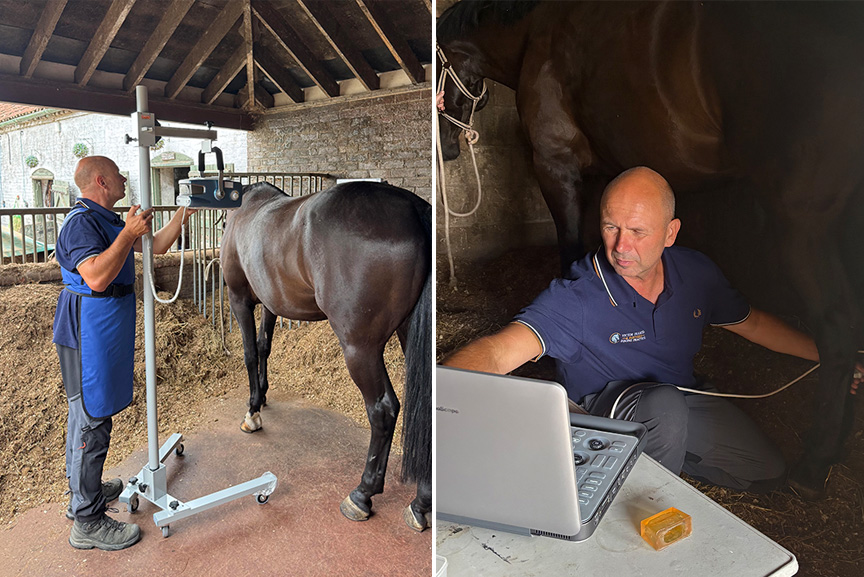
Once the affected area has been identified, we can perform diagnostic imaging using portable equipment at your yard whenever possible.
This may include:
In more complex cases, referral to an equine hospital for advanced imaging such as MRI, CT, bone scintigraphy (bone scan), or endoscopy may be recommended to achieve a definitive diagnosis.
The practice
If your horse is showing signs of lameness, stiffness, reluctance to work, behavioural changes under saddle, or a decline in performance, early investigation often leads to a faster diagnosis and improved long-term outcomes.
Contact us to arrange a comprehensive lameness or poor performance assessment at your yard.
To provide the best experiences, we use technologies such as cookies to store and/or access device information. Consenting to these technologies will allow us to process data such as browsing behaviour or unique IDs on this site. Not consenting, or withdrawing consent, may adversely affect certain features and functions.